The question mosque committees and administrators ask most often is: how much electricity does mosque under-carpet heating use? Because mosques are used intensively at certain times of day, consumption is calculated differently from homes. In this article we present a calculation method based on installed power, duty cycle and the prayer-time schedule, with a worked example.
The Values That Determine Consumption
- Installed power (kW): Net film area × film power. See mosque power calculation and control panel for the calculation.
- Zones switched on: Front rows only for daily prayers; the whole area for Friday and Eid prayers.
- Running time: Pre-heating + prayer time.
- Duty cycle: The thermostat runs the film intermittently; the cycle is high during the first warm-up of a cold mosque.
Consumption (kWh) = Power of active zones (kW) × Duty cycle × Time (hours)

Worked Example
Assumptions:
- Net film area 300 m², film power 150 W/m² → installed power 45 kW
- 15 zones of 3 kW each
- 5 zones (15 kW) on for each daily prayer, 1 hour per prayer (including pre-heating)
- All zones (45 kW) on for 2 hours for Friday prayers
- Average duty cycle 60%
| Item | Calculation | Result |
|---|---|---|
| Daily prayers per day | 15 kW × 0.6 × 5 hours | 45 kWh/day |
| Daily prayers per month | 45 × 30 days | 1,350 kWh |
| Friday prayers (additional) | 45 kW × 0.6 × 2 hours × 4 weeks | 216 kWh |
| Monthly total | ≈ 1,570 kWh |
Monthly cost = 1,570 kWh × the unit price per kWh for your mosque’s tariff group.
Values are for illustration only; the mosque’s insulation, climate zone, congregation size and thermostat settings will change the result.
What If There Were No Zoning?
If all 45 kW were switched on for every prayer in the same mosque: 45 × 0.6 × 5 = 135 kWh/day, or about 4,050 kWh per month. In this example, row-by-row zoning cuts consumption to roughly a third.
Ways to Reduce Consumption
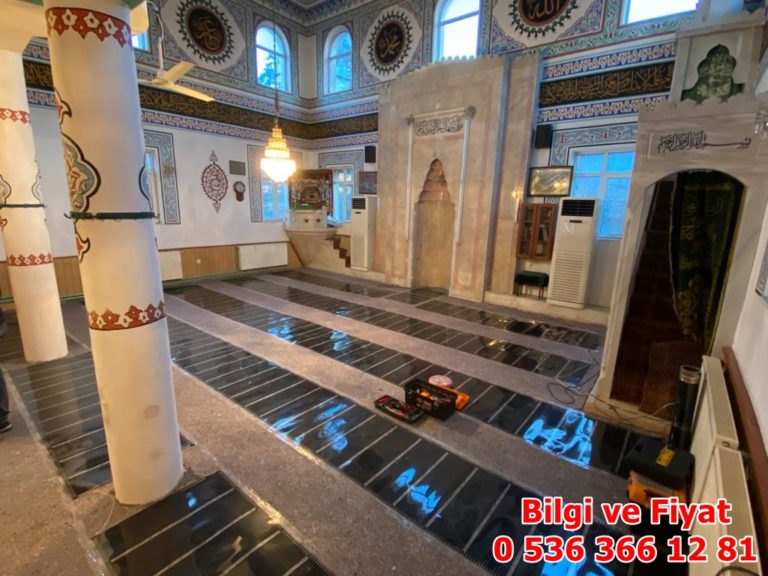
- Row-by-row zoning: Heat only the rows that are in use.
- Time scheduling: Switch the system on 30–45 minutes before prayer time and off after the prayer.
- Underlay insulation: Use thermal insulation felt beneath the film.
- Door and window insulation: Draught lobbies and door seals reduce cold air ingress.
- Sensible set temperatures: Set the floor limit to 27–29 °C and the room temperature as required.
For ready-made systems and panels, see our mosque heating system and 24-row mosque heating control panel.
Frequently Asked Questions
Why does the first warm-up use more energy?
The cold floor, carpet and walls absorb heat first, during which the film runs almost continuously. As the system warms up, the duty cycle drops.
Is it better to keep a low temperature all day or switch on for prayers?
If the mosque is used frequently and winters are very cold, keeping a low base temperature in the front rows can shorten the first warm-up. In general, prayer-time scheduling is more economical.
Conclusion
Mosque under-carpet heating consumption is calculated from installed power, active zones, running time and duty cycle. Zoning and time scheduling reduce consumption significantly. Read our mosque heating article for an overview, or contact us for a free consumption calculation and site survey for your mosque.