There are two keys to a successful mosque under-carpet heating project: an accurate power calculation and a well-designed control panel. An underpowered system cannot heat the mosque, while a poorly designed panel trips breakers, exceeds the electrical supply capacity or wastes energy. In this article we explain, with an example, how to calculate the power for mosque under-carpet heating and which components the control panel should contain.
1. Defining the Area to Be Heated
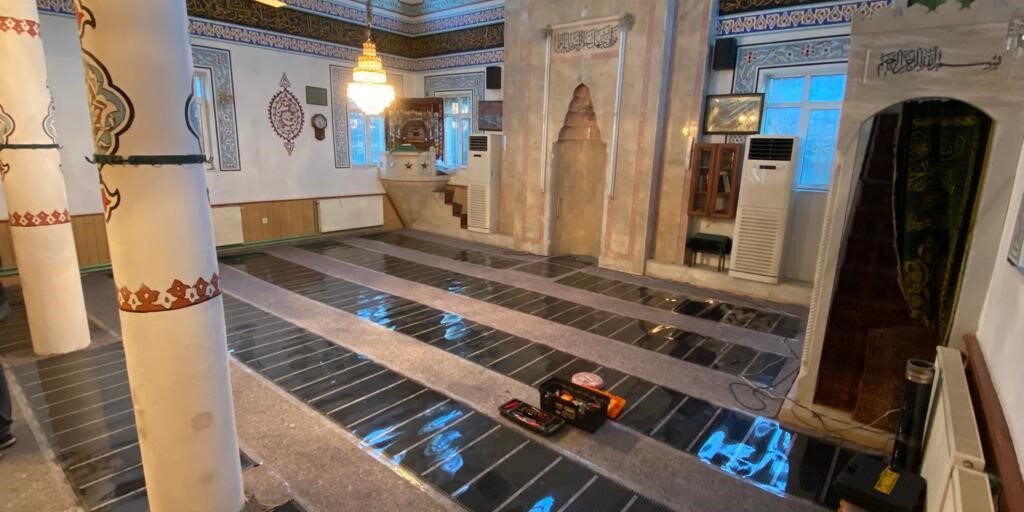
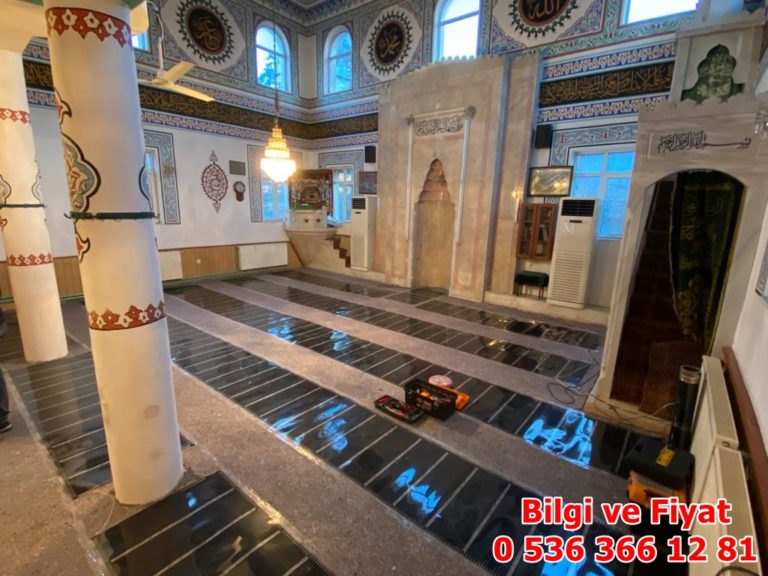
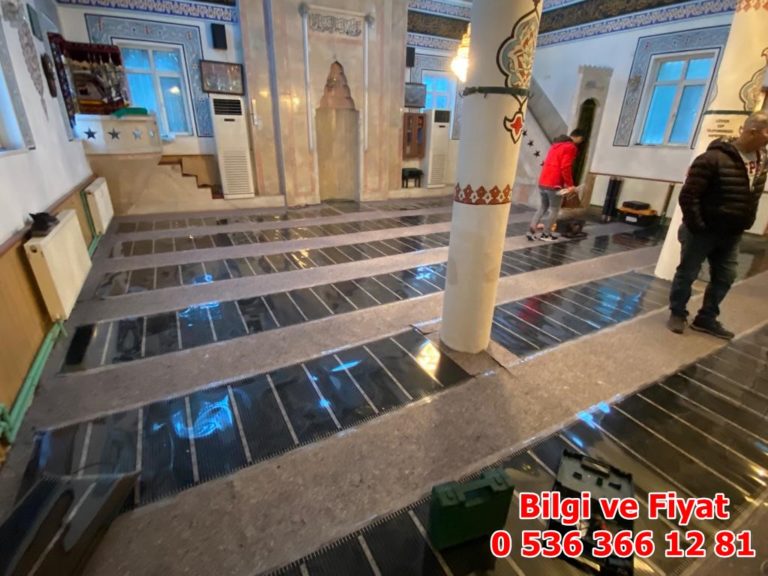
The power calculation is based not on the mosque’s total floor area but on the net area where film will be laid. The mihrab, minbar, kürsü, fixed cabinets and gaps along the walls are deducted. In practice, about 70–85% of the carpeted area is covered with film. Areas such as the women’s gallery and the outer prayer area (son cemaat yeri) should be planned as separate zones.
2. Choosing the Power Density
In mosques, film power is chosen according to the building’s insulation, the climate zone and whether the system is the main or a supplementary heat source. Under-carpet applications typically use films of 150–220 W/m². Higher values are preferred for poorly insulated mosques in cold regions; lower values for well-insulated buildings or supplementary heating.
3. Worked Power Calculation
Assumptions: 400 m² carpeted area, 75% coverage, 150 W/m² film.
- Net film area: 400 × 0.75 = 300 m²
- Installed power: 300 × 0.15 = 45 kW
- Load per phase when balanced across three phases: 15 kW
- Phase current (400 V, cosφ ≈ 1): 45,000 ÷ (1.73 × 400) ≈ 65 A
This load could, for example, be divided into 15 zones (groups of prayer rows) of about 3 kW each – 5 zones per phase, each drawing about 13 A.
Note: This calculation is for preliminary sizing only. The final design must be prepared by an electrical engineer, taking into account heat-loss calculations, cable lengths and voltage drop.
4. Checking the Electrical Supply Capacity
The existing supply capacity of many mosques is insufficient for a heating load of this size. Before starting the project:
- Check the mosque’s current supply capacity and main breaker rating.
- If necessary, apply to the distribution company for a capacity increase.
- If an increase is not possible, divide the system into zones and limit the load running at any one time (e.g. only the front rows for daily prayers).
5. Components the Control Panel Should Contain
| Component | Function |
|---|---|
| Main switch / MCCB | Protects the panel’s main incomer against overcurrent and short circuit, and isolates power during maintenance. |
| Surge protective device (SPD) | Protects the panel against mains surges. |
| Phase monitoring relay | Disables the system in the event of phase loss or under/overvoltage. |
| Zone circuit breakers (MCBs) | Protect each group of rows individually. |
| Residual current device (30 mA) | Used per zone or for small groups of zones for personal safety. |
| Contactors | Switch zones on and off according to the thermostat or time schedule. |
| Thermostat / temperature controller | Controls the contactors according to room and floor temperature. |
| Timer or smart controller | Switches the system on automatically before prayer times and off afterwards. |
| Indicator lamps and zone switches | Show which zones are running and allow manual on/off control. |
| Energy analyser (optional) | Monitors and reports consumption. |

For thermostat selection, see our carbon film heater thermostat guide.
6. Zoning (Row-by-Row Control)
Zoning is the most effective way to save energy in mosques:
- Daily prayers: Front rows only.
- Friday and Eid prayers: The entire prayer hall and galleries.
- Women’s gallery: A separate zone with its own schedule.
The timer can be set to switch the system on 30–60 minutes before prayer time. Bringing zones on in short steps rather than all at once prevents sudden load surges on the supply.
7. Cable and Circuit Design
- Zone supply cables must be sized for zone current and cable length, with voltage drop calculated.
- Run cables along the base of walls and through trunking so they are not crushed under the carpet.
- Insulate film connection points and bond all metal parts to the earthing system.
- Place the panel somewhere easily accessible, lockable and away from moisture.
Frequently Asked Questions
How much power does mosque under-carpet heating need?
Net film area × film power. For example, 300 m² of 150 W/m² film requires 45 kW of installed power. Actual consumption is lower, depending on duty cycle and hours of use.
Can a mosque be heated on a single-phase supply?
For small masjids, yes. Medium and large mosques need a three-phase supply for load balancing and capacity.
How is monthly consumption calculated?
Installed power × duty cycle × daily hours of use × number of days. See our electricity consumption guide for details.
Conclusion
Good results in mosque under-carpet heating come from defining the net area correctly, choosing a suitable power density, checking the supply capacity and using a zoned, fully protected control panel. Read our article on mosque heating for an overview, or contact us for a free site survey, power calculation and panel design for your mosque.