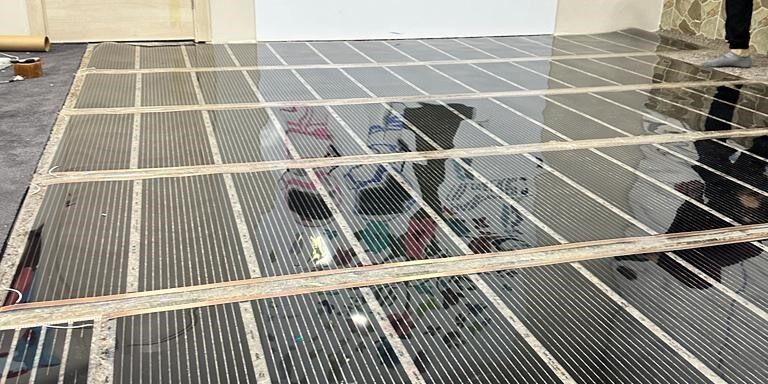
Carbon film heater electricity consumption is the number one question before buying. The good news is that you can estimate your bill quite realistically with just a few simple figures. In this guide we calculate the monthly bill step by step using installed power, duty cycle and hours of use.
The Three Values That Determine Consumption
- Installed power (kW): Film area laid × power per square metre of the film.
- Duty cycle (%): Thanks to the thermostat, the film runs intermittently, not continuously. The duty cycle shows what proportion of each hour it actually draws power.
- Hours of use: How many hours per day the system is switched on.
Combine these three values with the unit price per kWh on your electricity bill to calculate the cost.
Monthly Bill Formula
Monthly consumption (kWh) = Installed power (kW) × Duty cycle × Daily use (hours) × Number of days
Monthly cost = Monthly consumption (kWh) × Unit price per kWh
Step 1: Find the Installed Power
The film is laid over the living area not covered by furniture, not the whole room. In practice, around 60–80% of the floor area is covered. For example, if 14 m² of 220 W/m² film is laid in a 20 m² room: 14 × 0.22 = 3.08 kW.
Step 2: Estimate the Duty Cycle
The duty cycle depends on the building’s insulation and the outdoor temperature:
| Building Condition | Estimated Duty Cycle |
|---|---|
| Well-insulated, new building | 25 – 35% |
| Moderately insulated building | 35 – 50% |
| Poorly insulated, older building | 50 – 70% |
Step 3: Worked Example
A 20 m² room, 3.08 kW installed power, 40% duty cycle, 10 hours of use per day for 30 days:
- Average hourly consumption: 3.08 × 0.40 = 1.23 kWh
- Daily consumption: 1.23 × 10 = 12.3 kWh
- Monthly consumption: 12.3 × 30 ≈ 370 kWh
- Monthly cost at an example price of 4 TRY/kWh: 370 × 4 ≈ 1,480 TRY
Note: 4 TRY/kWh is only an example. Use the current unit price on your own bill (in your own currency).

Estimated Monthly Consumption by Room Size
The table below assumes 70% film coverage, 220 W/m² film, a 40% duty cycle, 10 hours of use per day and an example price of 4 TRY/kWh.
| Room | Film Area | Installed Power | Monthly Consumption | Monthly Cost |
|---|---|---|---|---|
| 10 m² | 7 m² | 1.54 kW | ≈ 185 kWh | ≈ 740 TRY |
| 15 m² | 10.5 m² | 2.31 kW | ≈ 277 kWh | ≈ 1,110 TRY |
| 20 m² | 14 m² | 3.08 kW | ≈ 370 kWh | ≈ 1,480 TRY |
| 25 m² | 17.5 m² | 3.85 kW | ≈ 462 kWh | ≈ 1,850 TRY |
| 30 m² | 21 m² | 4.62 kW | ≈ 554 kWh | ≈ 2,220 TRY |
For an alternative method based on heat loss and more detailed tables, see our article on underfloor heating electricity consumption.
What Increases and Reduces Your Bill
- Insulation: Poor insulation raises the duty cycle – it is the biggest factor.
- Thermostat setting: Each 1 °C increase raises consumption by roughly 6–7%.
- Underlay insulation: Without thermal insulation felt beneath the film, some heat is lost into the floor.
- Carpet thickness: Very thick carpets slow the transfer of heat into the room.
- Usage pattern: Not heating empty rooms and using a programmable thermostat deliver significant savings.
7 Tips to Lower Your Bill
- Use a weekly programmable or Wi-Fi thermostat. See our thermostat guide for help choosing one.
- Set the comfort temperature to 20–21 °C and the night temperature to 17–18 °C.
- Always lay thermal insulation felt beneath the film.
- Replace worn window and door seals.
- Keep unused rooms off or at a low setting with separate thermostats.
- Check your electricity tariff; time-of-use tariffs can be worthwhile if they suit your usage pattern.
- Do not lay film under furniture – it wastes energy and traps heat.
Frequently Asked Questions
How much electricity does a carbon film heater use per hour?
Installed power multiplied by the duty cycle. For example, with 3 kW installed and a 40% duty cycle, it uses about 1.2 kWh per hour on average.
Does a 220 W/m² film use twice as much as a 110 W/m² film?
No. In a thermostat-controlled system, consumption depends on the room’s heat loss. A higher-powered film warms the room faster and runs for shorter periods, so total consumption stays similar.
Is a carbon film heater more expensive to run than an air conditioner?
Air conditioners work on the heat pump principle and can produce the same amount of heat with less electricity. The advantages of carbon film are comfortable heat from the floor, silent operation and no maintenance. For comparisons, see underfloor heating vs radiators.
Conclusion
The monthly bill for a carbon film heater is easy to estimate from installed power, duty cycle, hours of use and unit price. Insulation and correct thermostat use are the most important factors. Contact us for a free power and consumption calculation for your space.