Installed correctly, an under-carpet heater will run safely, economically and trouble-free for many years. Poor installation, on the other hand, leads to lost efficiency, faults and safety risks. In this guide we cover preparation, step-by-step installation, first start-up and everyday use.
Before Installation
1. Measuring and Planning
Measure the room and decide where the film will be laid. Do not lay film under fixed furniture or furniture with closed bases, such as wardrobes and sofas. Films usually start 10–20 cm in from the walls.
2. Power and Electrical Supply
Calculate the total installed power and check that the existing circuit can carry the load. If necessary, add a dedicated circuit with a suitable circuit breaker and a 30 mA RCD. For power and consumption calculations, see our electricity consumption guide.
3. Materials List
- Carbon film heater (in a width and length to suit the room)
- Connection clamps and insulating tape
- Thermal insulation felt or reflective underlay
- Moisture barrier (polythene sheet)
- Supply cable
- Thermostat and floor sensor

Step-by-Step Installation
- Prepare the floor: Lift the carpets and sweep the floor. Remove sharp objects such as nails and stones.
- Lay the thermal insulation: Spread insulation felt or reflective underlay over the whole area so heat is not lost downwards.
- Fit the moisture barrier: Lay a polythene sheet over the insulation and tape the joints.
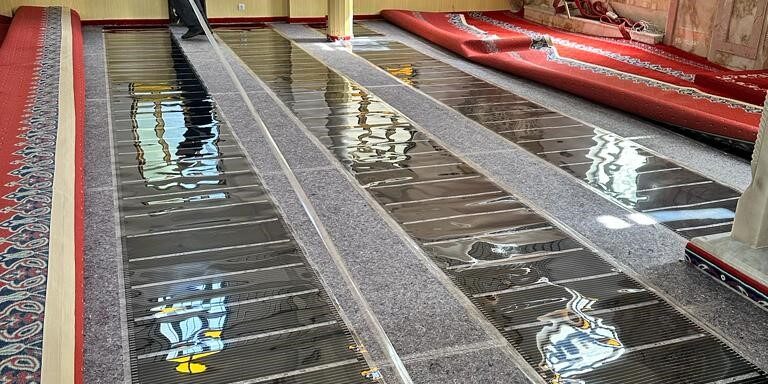
- Cut and lay the films: Cut the film only along the marked cutting lines. Lay the strips side by side, with the copper busbars on the same side and without overlapping.
- Insulate the cut ends: Seal the copper busbars at unconnected ends with insulating tape.
- Fit the clamps: Slide the clamps onto the copper busbar in the correct position and crimp them with pliers, then seal the connection on both sides with insulating tape.
- Connect the cables: Connect the film strips in parallel and run the supply cable to the thermostat or control panel.
- Position the floor sensor: Place the sensor between two film strips or under the film, as recommended by the manufacturer.
- Test: Before laying the carpet, measure insulation resistance and film resistance, then run the system briefly to check that every strip heats up.
- Lay the carpet: Lay the carpet over the film; never use nails or staples that could pierce the film.

Important: Electrical connections and panel work must be carried out by a qualified electrician. For the full set of safety rules, read are under-carpet heaters safe?
First Start-Up
- On the first day, set the thermostat to a low value (e.g. 18 °C) and let the system stabilise.
- If you have a floor sensor, keep the floor temperature limit at around 27–29 °C.
- There may be a faint smell on first use; it disappears quickly.
- Check by hand that every zone heats evenly.
Everyday Use
- Programme the thermostat rather than switching it on and off constantly; the system is most efficient with steady, small temperature differences.
- A room temperature of 20–22 °C is enough for comfort.
- Do not place floor mattresses, piles of cushions or furniture with closed bases on the heater.
- Do not wet-clean the carpet in place; if liquid is spilled, switch off and let it dry.
- Switch the system off at the thermostat in summer, and test the RCD once a year using its test button.

Common Installation Mistakes
- Cutting the film outside the marked cutting lines
- Overlapping or folding the films
- Omitting the underlay insulation
- Leaving connections without insulating tape
- Running the system without a thermostat or RCD protection
- Connecting a load that exceeds the thermostat’s current rating
Frequently Asked Questions
How long does installation take?
An average room can usually be completed in a few hours. Large areas such as mosques can take several days.
Can an under-carpet heater be used with any carpet?
No. Very thick carpets and carpets with rubber or plastic backing are not suitable. See which carpets suit carbon film heaters for details.
Can an under-carpet heater be moved?
The film can be lifted and moved to another room, but the connections must be remade and tested.
Conclusion
The efficient and safe operation of an under-carpet heater depends on correct planning, underlay insulation, sound connections and a suitable thermostat. Contact us for materials and turnkey installation. For the basics of carbon film, read what is a carbon film heater?