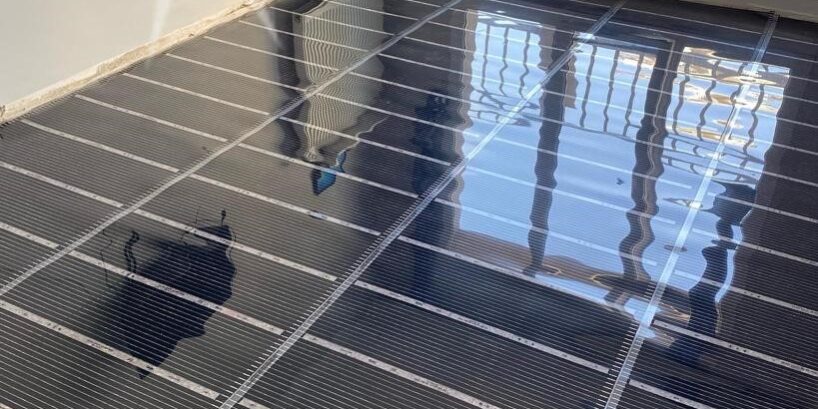
In small, lightweight spaces such as caravans and tiny houses, space, weight and energy are limited. At just a fraction of a millimetre thick, carbon film is a practical floor heating solution for these spaces. In this article we explain how to choose carbon film for caravan heating and tiny houses, how to calculate energy and how to install it.
Why Carbon Film?
- Thin and light: Adds virtually nothing to floor height or vehicle weight.
- No combustion products: No carbon monoxide, soot or odour in a small enclosed space.
- Silent: No fans or pumps.
- Even heat: Heats a small space evenly and keeps feet warm.
12 V or 230 V?
| Feature | 12 V Carbon Film | 230 V Carbon Film |
|---|---|---|
| Power source | Battery, solar system | Mains, campsite hook-up, inverter |
| Current | High (thick cable required) | Low |
| Use | Off-grid, spot heating | Main heating (when connected) |
| Suitable area | Small zones (beside the bed, seating area) | Whole floor |
For low-voltage needs, see our 12 V carbon film heater.
Battery and Energy Calculation (12 V)
In a 12 V system, current = power ÷ 12. Example:
- 2 m² film × 150 W/m² = 300 W → current ≈ 25 A
- With a thermostat at a 50% duty cycle, average consumption ≈ 150 Wh per hour
- A battery with about 1.2 kWh of usable capacity gives ≈ 8 hours of heating
For this reason, off-grid carbon film is usually used in small zones such as the seating area or beside the bed rather than across the whole floor. Cable cross-section must be chosen for the high current at 12 V, and the circuit must be fused.
230 V Systems
In caravans and tiny houses with a campsite or mains hook-up, 230 V film can be laid across the whole floor. Take care not to exceed the supply limit (e.g. the current limit of the campsite socket). Running from an inverter is generally suitable only for short periods because of battery capacity.
Insulation Is Essential
Caravan and tiny-house walls and floors are thin, so heat loss is high. Always lay thermal insulation underlay beneath the film and seal doors and windows. Details: should you lay felt underneath?
Installation and Safety
- Lay the film under laminate, vinyl (if the manufacturer permits) or carpet; never under cupboards or fixed furniture.
- Connections must be robust against vibration and fully insulated. See our cutting and connecting guide.
- Use a thermostat; for 12 V systems choose a 12 V-compatible thermostat (e.g. 12 V W3001 modules). See W3001 vs W3002.
- An RCD is mandatory on 230 V circuits.
Frequently Asked Questions
Is carbon film alone enough in a caravan?
With a mains hook-up and good insulation, it can be sufficient in small caravans. For off-grid use, it is usually chosen as supplementary heating.
Can carbon film run on solar panels?
Yes, but because solar output is low in winter, battery capacity and consumption must be calculated carefully.
Conclusion
Thin, light and free of combustion products, carbon film is a suitable floor heating solution for caravans and tiny houses. Choose 12 V or 230 V according to your power source. Contact us for the right product for your project.