
Contents
- What Is Cable Underfloor Heating?
- How It Works and Heat Distribution
- System Types and Components
- Technical Specifications
- Calculations: Power, Consumption and Cost
- Installation Steps
- Initial Investment Cost (Türkiye, 2026)
- Comparison with Other Heating Systems
- Frequently Asked Questions
- Maintenance and Troubleshooting
- Conclusion and Recommendations
1. What Is Cable Underfloor Heating?
Cable underfloor heating is a modern heating method that emits radiant heat upwards from the floor using electric heating cables or heating mats installed beneath the floor finish (screed, tiles, parquet or laminate). Unlike conventional radiators or air conditioners, it distributes heat evenly across the entire surface, and its temperature profile – warmest at foot level and decreasing upwards – is the most comfortable for the human body.
In Türkiye, cable underfloor heating has become popular in bathrooms, kitchens, hallways and living areas, and is used in everything from low-ceilinged flats to detached houses, offices and commercial premises. Its main attractions are invisible installation (no radiators or pipes), independent temperature control in every room, silent operation and a long service life (cable life of up to 50 years).
This guide is written for homeowners and end users. It explains how the system works, the available types, how much energy it uses per m², how to calculate monthly and annual bills, what to watch out for during installation, and answers to the most frequently asked questions.
1.1 Key Advantages
- Even heat distribution: the whole floor works like one large radiator, with no cold corners or draughts.
- Comfort: heat decreases from foot level upwards (ideal physiological profile: 24–26 °C at the feet, 20–22 °C at head height).
- Invisible installation: no radiators on the walls or air-conditioning units on the ceiling; complete freedom for furniture layout.
- Silent operation: no moving parts or fans.
- Zone control: each room can have its own thermostat, so no energy is used in unoccupied rooms.
- Hygiene: no dust is stirred up and no draughts are created – suitable for people with allergies and asthma.
- Long life: quality heating cables last up to 50 years; thermostats are typically replaced every 10–15 years.
- Low maintenance: the cable needs no maintenance; only the thermostat and breakers need checking.
1.2 Limitations to Consider
- Initial investment: approx. 1,500–3,500 TRY per m² including cable, thermostat and installation (2026 prices, depending on system type).
- Warm-up time: with thick screed systems, full warm-up takes 2–6 hours, so the system should be kept at a low background temperature or programmed with a smart thermostat.
- Dependence on electricity: electricity is the only energy source; choosing the wrong tariff (day/night) increases costs.
- Difficult repairs: if a cable fails, the floor may need to be opened, which is why an insulation test before finishing is essential.
- Inefficiency in buildings with high heat loss: in a poorly insulated space, underfloor heating alone may be insufficient – improve the insulation first.
2. How It Works and Heat Distribution
At the heart of a cable underfloor heating system is a resistive conductor that converts electrical energy directly into heat. As the 230 V mains supply passes from the thermostat through the heating cable laid beneath the floor, heat is generated by the cable’s internal resistance through the Joule effect (Q = I²·R·t). This heat passes first into the surrounding screed or adhesive layer, then into the floor finish (tiles, parquet, laminate) and finally into the room.
2.1 Radiant Heat and the Comfort Profile
Heat transfer from underfloor heating is mostly by radiation; only about 20–30% is by convection (air circulation). Radiant heat warms surfaces and objects directly rather than the air, which has two important consequences:
- The perceived temperature is 2–3 °C higher than the thermostat value – set the thermostat to 20 °C and it feels like 22–23 °C – so less energy is needed for the same comfort.
- The temperature difference from floor to ceiling is only 2–3 °C (6–8 °C with radiators), so very little heat is wasted at the ceiling.
2.2 Typical Temperature Profile
In a correctly designed cable underfloor heating system, operating temperatures are in the following ranges:
| Measuring Point | Target Temperature | Notes |
|---|---|---|
| Cable surface (in screed) | 35–45 °C | Maximum 65 °C – higher shortens cable life |
| Floor surface (tiles/parquet) | 24–29 °C | 27 °C ideal for living areas, 29 °C for bathrooms |
| Foot level (0–10 cm) | 23–26 °C | Temperature felt through direct foot contact |
| Seated level (60–110 cm) | 21–23 °C | The level read by the thermostat |
| Head height (170 cm) | 19–21 °C | Only 4–5 °C difference between feet and head |
2.3 Floor Finishes and Heat Transfer
The thermal conductivity of the floor finish (λ, W/m·K) directly affects efficiency. The more conductive the finish, the faster the system warms up and the less power is needed for the same comfort:
| Floor Finish | Thermal Conductivity (λ) | Suitability for Underfloor Heating |
|---|---|---|
| Ceramic / porcelain tiles | 1.0–1.3 W/m·K | Excellent – the most common choice |
| Natural stone (marble, granite) | 2.0–3.5 W/m·K | Excellent – high heat capacity |
| Micro-cement / screed | 1.4–1.7 W/m·K | Very good |
| Engineered/laminate flooring (UFH-rated) | 0.15–0.20 W/m·K | Good – choose products labelled for underfloor heating |
| Solid wood parquet | 0.12–0.18 W/m·K | Fair – max. 27 °C surface temperature recommended |
| Carpet / thick rugs | 0.05–0.07 W/m·K | Poor – not recommended above 1.5 tog |
| Vinyl / LVT | 0.17–0.25 W/m·K | Good – use products rated for underfloor heating |
3. System Types and Components
There are four main types of cable underfloor heating. The choice depends on available floor height, floor finish, how the space is used and budget.
3.1 Heating Cable (In-Screed System)
A standard (3.5–6 mm diameter) single- or twin-conductor insulated heating cable. Before the screed is poured, it is laid in a serpentine or spiral pattern at 5–25 cm spacing on thermal insulation boards, then covered with 4–6 cm of screed. The screed acts as a thermal mass, storing heat and spreading it evenly to the floor surface.
Applications: new builds, large living areas, lounges, hallways, bedrooms and offices. Because the screed is 4–6 cm thick, warm-up takes 2–4 hours; in return, thermal inertia is high (it keeps releasing heat for hours after switching off).
Advantages: the lowest cost per m²; long life (50+ years); high power (150–200 W/m²) heats large areas efficiently.
Disadvantages: cannot be retrofitted to an existing floor (screed must be poured); raises floor height by 6–10 cm.
3.2 Heating Mat – Under Tiles
A thin heating cable (2.5–3.5 mm) factory-fixed to a mesh carrier at a fixed spacing (usually 5 cm). It comes in rolls that are unrolled and bonded directly onto the existing floor with adhesive, then covered with a thin layer of tile adhesive (3–6 mm) and ceramic or porcelain tiles.
Applications: ideal for adding to an existing floor during renovation; the most common solution for bathrooms, kitchens, hallways and small rooms.
Advantages: raises the floor by only 3–5 mm; quick and easy to install; short warm-up time of 20–45 minutes.
Disadvantages: 20–40% more expensive per m² than in-screed cable; standard widths (50 cm) can create waste in irregular areas; power density limited to 100–150 W/m².
3.3 Thin (Micro) Cable – Self-Adhesive Systems
An extra-thin heating cable 1.8–2.5 mm in diameter whose spacing can be adjusted freely (5–15 cm). Its self-adhesive backing allows it to be stuck directly onto the existing floor, then covered with self-levelling compound (3–8 mm) or directly with tile adhesive.
Applications: irregularly shaped bathrooms, around WCs and under basins – tight or complex areas; renovations where the existing floor cannot be lifted.
Advantages: raises the floor by only 2–4 mm (the thinnest cable solution); no waste in irregular spaces; heats every point evenly.
Disadvantages: the most expensive option per m²; calculating the laying spacing requires professional support.
3.4 Carbon Heating Film – Under Laminate/Parquet
A polymer film 0.3–0.4 mm thick with conductive carbon strips. It needs no screed or adhesive; it is laid directly on a heat-reflective underlay and covered with laminate or floating parquet. Technically it is not a “cable”, but it is a type of underfloor heating and end users generally group it in the same category.
Applications: dry rooms such as living rooms, bedrooms and children’s rooms with laminate or parquet.
Advantages: very thin (1–2 mm build-up); dry installation (no screed or adhesive); surface heating rather than line heating.
Disadvantages: cannot be used in wet rooms such as bathrooms and kitchens; not laid under tiles; average life 25–30 years (shorter than cable).
3.5 System Types Compared
| Feature | In-Screed Cable | Heating Mat | Thin Cable | Carbon Film |
|---|---|---|---|---|
| Floor build-up | 6–10 cm | 3–5 mm | 2–4 mm | 1–2 mm |
| Warm-up time | 2–4 hours | 20–45 min | 15–30 min | 10–20 min |
| Power density | 150–200 W/m² | 100–150 W/m² | 100–200 W/m² | 60–220 W/m² |
| Suitable floor finishes | All | Tiles, stone | Tiles, stone | Laminate, parquet |
| Bathroom / wet rooms | Yes | Yes | Yes | No |
| Application | New build | Renovation | Renovation | Renovation |
| Average price per m² (2026) | 1,500–2,200 TRY | 2,000–2,800 TRY | 2,500–3,500 TRY | 1,800–2,600 TRY |
| Expected life | 50+ years | 30–40 years | 30–40 years | 25–30 years |
4. Technical Specifications
The main components of a cable underfloor heating system are the heating cable (or mat), thermostat, floor sensor, thermal insulation board, cold tail and electrical junction box. The technical parameters of each directly determine efficiency and safety.
4.1 Heating Cable – Construction and Types
Modern heating cables are multi-layered: an inner resistive conductor (nickel-chrome or FeCrNi alloy), inner insulation (FEP or silicone), an earth braid (usually copper or tinned copper), an outer sheath (PVC or halogen-free LSZH) and sometimes a protective metal braid. This construction resists mechanical impact, damp environments and electromagnetic interference.
- Single-conductor: both ends of the cable return to the thermostat box. Lower cost, but both ends must be brought back to the same point.
- Twin-conductor: one end of the cable is sealed and only one end is connected. Its magnetic field is close to zero (better for EMC), installation is simpler, and it is the most common choice for end users.
- Self-regulating: mainly used for frost protection of pipes and gutters; resistance rises with temperature, reducing output. Rarely used for underfloor heating.
4.2 Power Density (W/m²) and Selection
Power density is the electrical power per square metre of floor and determines how much the system will heat. Recommendations by use:
| Use | Recommended Power | Notes |
|---|---|---|
| Comfort heating (supplementary) | 100–120 W/m² | Bathroom, kitchen – main heating from another system |
| Primary heating (insulated building) | 130–160 W/m² | Living areas, bedrooms – the only heat source |
| Primary heating (moderately insulated) | 150–180 W/m² | Older buildings, poorly insulated areas |
| High heat-loss areas | 180–200 W/m² | Basements, ground floors, rooms with large glazing |
| Porches, conservatories | 200–230 W/m² | Maximum recommended power |
Important: systems above 200 W/m² can overheat the floor surface (>29 °C), which reduces comfort (a feeling of sweating) and can damage materials such as parquet. Under EN 1264-2, floor surface temperature is limited to 29 °C in living areas and 33 °C in bathrooms.
4.3 Voltage and Electrical Connection
| Parameter | Value / Range |
|---|---|
| Operating voltage | 230 V AC, 50 Hz (standard mains in Türkiye) |
| Tolerated voltage range | 207–253 V (±10%) |
| Maximum current (single circuit) | 16 A (breaker limit) |
| Maximum power per circuit | 16 A × 230 V = 3,680 W ≈ 3.7 kW |
| Maximum area per circuit (150 W/m²) | ≈ 24 m² |
| Protection | 16 A type-C MCB + 30 mA RCD |
| Earthing | Mandatory – TT or TN-S system |
| IP rating (bathroom) | Minimum IPX4 (cable) – IP21 (thermostat) |
4.4 Thermal Insulation Board (Important!)
A 6–30 mm XPS (extruded polystyrene) or PIR insulation board beneath the heating cable prevents heat escaping downwards (to the neighbours below, the slab or the ground). In systems laid without proper insulation, 30–50% of the heat is lost downwards and bills can double. Minimum recommended thickness: 20 mm over ground floors or basements, 6–10 mm on intermediate floors.
5. Calculations: Power, Consumption and Cost
Accurate calculation is critical for both the success of the system and your electricity bill. This section calculates step by step: (a) the area to be heated, (b) installed power, (c) daily, monthly and annual consumption and (d) cost based on Turkish electricity tariffs.
5.1 Net Heated Area
Areas where no cable will be laid are deducted from the total area: fixed furniture (built-in wardrobes, kitchen units, bath, WC, basin) and anything that blocks access. As a rule: net area = gross area × 0.70–0.85.
Formula 1: Net heated area = Gross area − Fixed furniture area − 10 cm wall margin
Example: a 6 m² gross bathroom. Bath (1.5 m²) + WC (0.3 m²) + basin (0.5 m²) + wall margin (0.4 m²) = 2.7 m². Net heated area = 6 − 2.7 = 3.3 m².
5.2 Installed Power (kW)
Formula 2: Installed power (W) = Net area (m²) × Power density (W/m²)
Example: 3.3 m² net bathroom area × 150 W/m² = 495 W (≈ 0.5 kW). This is the maximum instantaneous power the system will draw – even if the thermostat kept the cable on continuously, it would use 0.5 kWh per hour.
5.3 Daily and Monthly Electricity Consumption (kWh)
Underfloor heating does NOT run continuously; the thermostat switches it off when the target temperature is reached and on only when needed. Actual consumption is therefore only a fraction of installed power. This ratio is called the duty cycle and varies as follows:
| Scenario | Duty Cycle | Notes |
|---|---|---|
| Transitional season (October, April) | 15–25% | Runs 4–6 hours a day |
| Normal winter (November, March) | 30–40% | Runs 7–10 hours a day |
| Harsh winter (December–February) | 40–55% | Runs 10–13 hours a day |
| Highly insulated building (TS 825) | 20–30% | Season average |
| Poorly insulated building | 45–60% | Season average |
Formula 3: Daily consumption (kWh) = Installed power (kW) × Active hours (h/day)
Example: 0.5 kW installed power × 8 hours (normal winter, 33% duty cycle) = 4.0 kWh/day. Monthly consumption = 4.0 × 30 = 120 kWh/month.
5.4 Annual Consumption and Cost (Türkiye, 2026)
In Türkiye, the residential tier-1 electricity price (first 240 kWh/month) was around 2.80 TRY/kWh at the start of 2026, and tier-2 (above 240 kWh) around 4.20 TRY/kWh. With a multi-rate tariff, the night rate (22:00–06:00) falls to about 1.90 TRY/kWh, so using the night tariff with a smart thermostat delivers significant savings.
Note: the cost tables below assume an average single-rate tariff of 3.20 TRY/kWh. Tariffs are updated quarterly by EPDK (the Turkish Energy Market Regulatory Authority); check your distribution company’s tariff – or your local tariff if you are outside Türkiye.
5.4.1 Scenario 1: 3.3 m² Bathroom (Supplementary Comfort Heating)
| Parameter | Value |
|---|---|
| Net area | 3.3 m² |
| Power density | 150 W/m² |
| Installed power | 495 W (0.5 kW) |
| Active hours per day (winter avg.) | 6 hours |
| Daily consumption | 3.0 kWh |
| Monthly consumption (winter, 30 days) | 90 kWh |
| Monthly cost (3.20 TRY/kWh) | ≈ 288 TRY |
| Heating season (5 months: November–March) | 450 kWh / 1,440 TRY |
| Transitional months (2 months, 50% use) | 90 kWh / 288 TRY |
| ANNUAL TOTAL | ≈ 540 kWh / 1,728 TRY |
5.4.2 Scenario 2: 30 m² Living Room (Primary Heating)
| Parameter | Value |
|---|---|
| Gross area | 30 m² |
| Net area (fixed furniture −20%) | 24 m² |
| Power density | 160 W/m² |
| Installed power | 3,840 W (3.84 kW) |
| Active hours per day (winter avg.) | 9 hours |
| Daily consumption | 34.6 kWh |
| Monthly consumption (winter, 30 days) | 1,037 kWh |
| Monthly cost (mixed tier-1/tier-2, avg. 3.80 TRY/kWh) | ≈ 3,941 TRY |
| Heating season (5 months) | 5,185 kWh / 19,703 TRY |
| Transitional months (2 months) | 1,040 kWh / 3,952 TRY |
| ANNUAL TOTAL | ≈ 6,225 kWh / 23,655 TRY |
Thanks to the lower thermostat setting that radiant heat allows, this consumption is typically 30–45% lower than heating the same area with conventional resistive (panel) electric heaters. An inverter air conditioner (heat pump) produces the same heat with less electricity, and natural gas radiators are cheaper to run (natural gas ≈ 2.30 TRY/m³ at the start of 2026); underfloor heating is chosen for its comfort, invisibility, ease of installation and suitability where there is no gas supply.
5.5 Quick Estimate Table (Annual Consumption)
The table below estimates annual consumption and cost for a well-insulated home with 150 W/m² power density in an average winter (7-month active season, an average of 8 hours’ operation per day).
| Net Area | Installed Power | Annual Consumption | Annual Cost (3.20 TRY/kWh) |
|---|---|---|---|
| 5 m² (small bathroom) | 0.75 kW | ≈ 820 kWh | ≈ 2,624 TRY |
| 10 m² (kitchen) | 1.5 kW | ≈ 1,640 kWh | ≈ 5,248 TRY |
| 15 m² (bedroom) | 2.25 kW | ≈ 2,460 kWh | ≈ 7,872 TRY |
| 20 m² (medium room) | 3.0 kW | ≈ 3,280 kWh | ≈ 10,496 TRY |
| 30 m² (living room) | 4.5 kW | ≈ 4,920 kWh | ≈ 15,744 TRY |
| 50 m² (large flat) | 7.5 kW | ≈ 8,200 kWh | ≈ 26,240 TRY |
| 80 m² (whole flat) | 12.0 kW | ≈ 13,120 kWh | ≈ 41,984 TRY |
Saving tip: using the night tariff (22:00–06:00) with a smart thermostat and programmed setbacks reduces annual costs by 20–35%. The annual cost for a 30 m² living room then falls to around 10,000–12,500 TRY.
6. Installation Steps
Done in the right order, laying a cable underfloor heating system is a relatively simple job that can be completed in a day. However, the electrical connection must always be made by a qualified electrician or electrical engineer. The professional installation sequence is described below:
6.1 Stage 1 – Preparation and Surface Cleaning
- Clean the existing floor thoroughly, removing dust, mortar residue, nails and screws. Level any rough surfaces.
- Check the floor is flat (max. 3 mm deviation over a 3 m straightedge). If there are hollows, pour self-levelling screed.
- Decide the thermostat position (next to the door, at light-switch height, 1.2–1.5 m above the floor).
- Chase a channel in the wall for the thermostat cable and fit 16 mm flexible conduit to the box.
- Isolate the supply and allocate a 16 A type-C MCB and 30 mA RCD in the consumer unit.
6.2 Stage 2 – Thermal Insulation Board
- Lay 20 mm XPS boards over the whole floor, starting from the walls.
- Tape the board joints with aluminium tape (to prevent thermal bridging).
- Fix a 5 mm perimeter edge strip around the walls to absorb thermal expansion of the screed.
- Lay plastic cable-fixing strips or a fixing mat on top of the insulation boards.
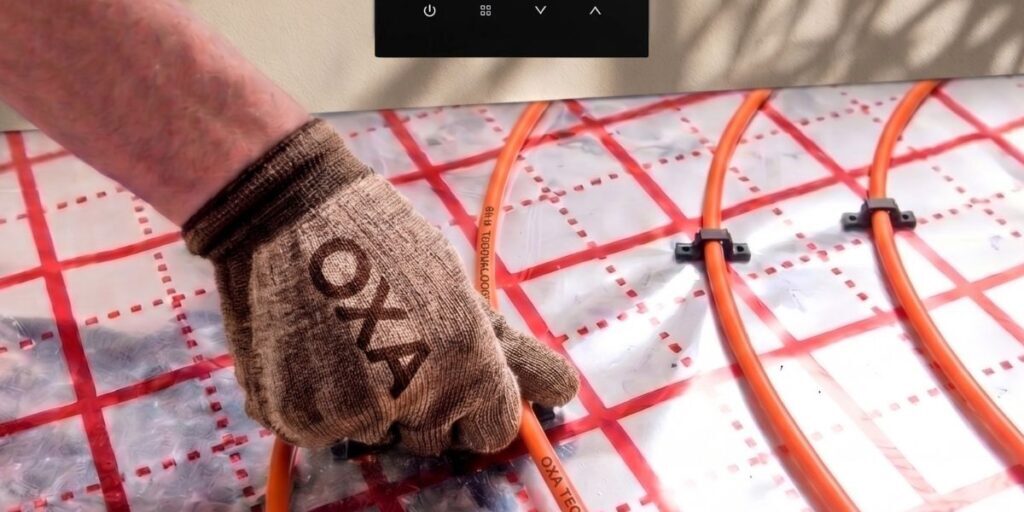
6.3 Stage 3 – Laying the Heating Cable
- Prepare the manufacturer’s layout sketch: cable length = (net area ÷ cable spacing) + 10% allowance.
- Run the cold tail (connection end) to the thermostat box – this section does not heat; it is the connecting cable.
- Lay the cable in a serpentine pattern of parallel runs, clipped into the fixing strips.
- Cable spacing: 10 cm for 150 W/m², 13–15 cm for 100 W/m², 7.5 cm for 200 W/m².
- Cables must NEVER touch or cross (overheating → cable burnout). Keep at least 5 cm apart.
- Keep at least 10 cm from walls and fixed objects such as baths and WCs.
- Place the floor sensor exactly midway between two cable runs, inside the conduit leading to the thermostat box.
- Measure the cable resistance with an ohmmeter and compare it with the label value (±10% tolerance).
- Measure insulation resistance with a 500 V megger: it must be > 20 MΩ.
6.4 Stage 4 – Pouring the Screed
- Screed thickness: min. 30 mm and max. 50 mm above the cable (the optimum range for heat transfer).
- Preferably use a self-levelling screed suitable for underfloor heating (anhydrite or cement-based).
- Add a plasticiser designed for underfloor heating to the screed – it improves workability and ensures full contact around the cable with no air pockets.
- Walk on rubber-soled shoes and do not use sharp trowels, to avoid damaging the cable.
- Wait at least 28 DAYS after pouring; running the system before then will crack the screed.
6.5 Stage 5 – Commissioning
- Once the screed is fully cured (28 days), start the system at 15 °C and raise it by 2–3 °C a day to comfort temperature – this is the ramped commissioning regime.
- Set the thermostat’s floor sensor limit to max. 28 °C (26 °C for parquet).
- Programmable thermostat: a schedule of 18 °C during working hours, 22 °C when at home and 19 °C at night is recommended.
- During the first week, check operation for 1–2 hours a day and monitor any change in resistance with an ohmmeter.
- Handover: record the cable resistance, insulation resistance, date and installer’s signature.
WARNING: Once underfloor heating cable has been laid, NO nails, screws or wall plugs may be driven into the floor. Even skirting boards must be fixed to the wall, not the floor. Keep the as-built drawing and photographs, and show them to your electrician before any future renovation.
7. Initial Investment Cost (Türkiye, 2026)
The initial investment for cable underfloor heating comprises the cable/mat, thermostat, insulation board, screed, electrical installation and labour. Approximate unit prices across Türkiye at the start of 2026:
| Item | Unit Price | Notes |
|---|---|---|
| Heating cable (premium brand, 150 W/m²) | 750–1,200 TRY/m² | European brands (Devi, Raychem, Warmup, etc.) |
| Heating cable (mid-range) | 450–700 TRY/m² | Turkish-made, CE certified |
| Heating mat system (ready-made) | 550–850 TRY/m² | Fast installation, for low-profile spaces |
| Smart thermostat (Wi-Fi, programmable) | 2,500–6,500 TRY each | Tuya, Honeywell, Siemens, Devi |
| Basic thermostat (manual) | 750–1,500 TRY each | Digital display, non-programmable |
| XPS insulation board (20 mm) | 150–220 TRY/m² | 20 mm thick, λ = 0.033 |
| Self-levelling screed (per cm thickness) | 120–180 TRY/m² | 360–540 TRY/m² for 30 mm |
| Electrical installation and protection | 1,500–3,000 TRY | 16 A type-C MCB + 30 mA RCD + wiring |
| Labour (cable laying + screed) | 350–650 TRY/m² | Qualified installer, 2,500–4,000 TRY per day |
| TOTAL (mid-range, 10 m² space) | ≈ 16,000–28,000 TRY | Complete, including thermostat, turnkey |
| TOTAL (premium, 10 m² space) | ≈ 24,000–42,000 TRY | European cable + smart thermostat |
A budget of 20,000–25,000 TRY is generally sufficient for a standard 10 m² bathroom; a whole 80 m² flat requires 160,000–250,000 TRY. Although the initial investment looks high, with a system life of 30–50 years the annual depreciation is around 6,000–9,000 TRY.
8. Comparison with Other Heating Systems
| Criterion | Cable Underfloor | Gas Boiler + Radiators | Air Conditioner (Inverter) | Electric Panel Heaters |
|---|---|---|---|---|
| Initial investment (100 m²) | 200–280k TRY | 60–100k TRY | 80–140k TRY | 30–50k TRY |
| Monthly running cost (winter) | 12–18k TRY | 4–7k TRY | 8–12k TRY | 18–28k TRY |
| Comfort (temperature distribution) | Excellent | Very good | Moderate (blows warm air) | Low |
| Visual impact | Invisible | Visible radiators | Visible indoor unit | Visible appliance |
| Noise | Silent | Silent | Slight fan noise | Silent |
| System life | 30–50 years | 15–25 years | 10–15 years | 5–10 years |
| Annual maintenance cost | None | 1,000–2,500 TRY | 500–1,500 TRY | None |
| Gas supply required? | No | Yes | No | No |
| Cooling capability | No | No | Yes | No |
Conclusion: in a home with a gas supply, a gas combi boiler with radiators is still the cheapest option on running cost alone, and an inverter air conditioner is also cheaper to run than resistive electric heating. However, in areas without gas, in high-end renovations, in offices and retail spaces and for spot heating in bathrooms and kitchens, cable underfloor heating offers unrivalled comfort. Compared with air conditioning – especially in homes with babies or elderly people – the absence of draughts and its hygiene (no dust stirred up) are important advantages.
9. Frequently Asked Questions
The following are the questions end users and homeowners ask most often when deciding on cable underfloor heating. The answers draw on installation experience in Türkiye and the framework of EN 1264, TS 825 and occupational health and safety regulations.
Q: How much does cable underfloor heating add to the electricity bill?
A: In a typical 100 m² home heated throughout, it adds around 12,000–18,000 TRY per month during the heating season. For a bathroom alone (5 m²), the extra bill is about 250–350 TRY per month. Costs depend heavily on the building’s insulation and the thermostat setting.
Q: Is underfloor heating harmful to health?
A: No. The cables are earthed, twin-conductor and double-insulated, and their magnetic field is lower even than a mobile phone (<0.2 μT at 30 cm). On the contrary, because it creates no draughts, no dust is stirred up – much healthier than air conditioning for people with asthma and allergies.
Q: Which floor finishes are compatible?
A: Ceramic tiles and natural stone (the best choice, λ = 1.3–3.5 W/m·K), porcelain, marble and granite are fully compatible. Vinyl/LVT can be used with certain brands (labelled for underfloor heating), limited to max. 27 °C. Laminate runs at max. 26 °C and solid parquet at max. 25 °C; carpet should be below 1.5 tog (thick carpet smothers the system).
Q: What happens in a power cut? Will the cable be damaged?
A: No. A power cut switches the system off without harming the cable, and the thermostat resumes when power returns. However, cuts longer than 4 hours affect comfort in mid-winter; where this is critical, a generator or back-up panel heater can be kept.
Q: If a cable fails, does the whole system need replacing?
A: No. The fault is located with a thermal camera, only about 30 × 30 cm of screed is broken out at that point, and the cable is spliced or the junction box renewed. Such faults are extremely rare – cable life is 30–50 years.
Q: Can I install underfloor heating as a tenant?
A: Because the system is permanently embedded in the floor, it is not a suitable tenant investment. You should obtain the landlord’s consent, add a clause to the tenancy agreement and share the cost (tenants generally cannot recover the investment).
Q: Is a heated rug (electric floor mat) a suitable alternative?
A: Heated rugs (surface mats) only provide comfort, not main heating. They draw 100–200 W and only warm the spot where you are standing. They are not a permanent solution – suitable for tenants or anyone seeking a temporary fix.
Q: What is the payback period?
A: In a home without gas, compared with conventional electric panel heaters, annual savings of around 25,000–40,000 TRY can be achieved, so a 200,000 TRY investment can pay for itself in 5–8 years. With a system life of 30+ years, the remaining 22–25 years are net gain. Compared with an inverter air conditioner, the benefit lies in comfort and longevity rather than lower running cost.
Q: How should the system be looked after in summer?
A: At the end of the season, switch it off completely at the thermostat. In summer the cable lies passive beneath the floor and needs no maintenance. Switching off the MCB in the consumer unit is also recommended to save electricity (thermostats draw ~2 W on standby).
Q: Why does underfloor heating succeed in some homes and fail in others?
A: Three main factors: (1) Building insulation – in older buildings that do not meet TS 825, heat loss is high and the system is inadequate. (2) Correct power density – if 80 W/m² is installed where 100 W/m² is needed, the system cannot cope. (3) Correct use – keeping the system at a steady low temperature (19–20 °C) is far more economical than boosting it to 25 °C each morning.
10. Maintenance and Troubleshooting
A major advantage of cable underfloor heating is that it needs no regular maintenance – a correctly installed system runs for 30 years without intervention. Even so, there are a few practical checks you should carry out as a user:
10.1 Annual Checks
- At the start of the season (October), run the system for an hour and check that the whole surface heats evenly.
- If there are cold spots (no heat in one area), have a qualified technician inspect it with a thermal camera.
- Replace the thermostat batteries (if battery-powered).
- Press the test button on the 30 mA RCD in the consumer unit to check it works (once a year).
10.2 Common Problems and Solutions
| Symptom | Possible Cause | Solution |
|---|---|---|
| System does not heat at all | RCD tripped, breaker off, thermostat off | Check the consumer unit |
| One area is cold | Cable fault or poor connection | Qualified technician – thermal camera |
| Thermostat shows “sensor error” | Floor sensor cable broken | Replace the sensor (15–25 min job) |
| RCD keeps tripping | Insulation damage (water leak?) | Switch off – technician essential |
| Bill higher than expected | Set temperature too high or window open | 22 °C → 21 °C: 7% saving |
| Floor too hot (>30 °C) | Faulty sensor or thermostat | Switch off and test the sensor |
| System slow to warm up | Normal for screed – 2–4 hours | Bring forward with programming |
11. Conclusion and Recommendations
Cable underfloor heating is a completely hidden, silent and hygienic heating solution that delivers the highest level of comfort in today’s residential and commercial buildings. In properly insulated buildings (TS 825 compliant), with the right power density (130–160 W/m² for living areas, 150 W/m² for wet rooms) and programmed with a smart thermostat, it can be used economically.
Decision recommendations:
- If there is NO gas supply – underfloor heating offers far greater comfort than air conditioning and lower running costs than electric panel heaters; an inverter air conditioner remains cheaper to run, so the two are often combined.
- If there IS a gas supply and it is a new build – underfloor heating in spot areas such as bathrooms, kitchens and hallways combined with gas radiators is the best balance of comfort and cost.
- If you are renovating – if screed is being poured anyway, adding the system for a marginal extra cost (≈700 TRY/m² for cable and boards) is highly worthwhile.
- If there are babies, elderly people or allergy sufferers – underfloor heating is healthier because it does not stir up dust or create draughts.
- Strongly recommended for bathrooms – it eliminates cold tiles, is safe for children and is the detail that most improves quality of life.
- If your budget is limited – install it only in wet rooms such as the bathroom and kitchen; a total investment of 15–25 m² is in the 25,000–45,000 TRY range.
- Always choose a qualified installer – do not accept a system without a cable splice record, measurement report and warranty certificate.
This guide is for information only. Because every installation has its own structural conditions, a site survey and technical advice from a qualified mechanical or electrical engineer are always recommended for your project.
© 2026 oxatechnologies.com – All rights reserved. This content may not be copied or reproduced in whole or in part without attribution.
Related articles:
- Underfloor heating electricity consumption: calculation and table
- How to install screedless underfloor heating
- Underfloor heating vs radiators
- Types of underfloor heating systems
Contact us for a free site survey and quotation for your project.