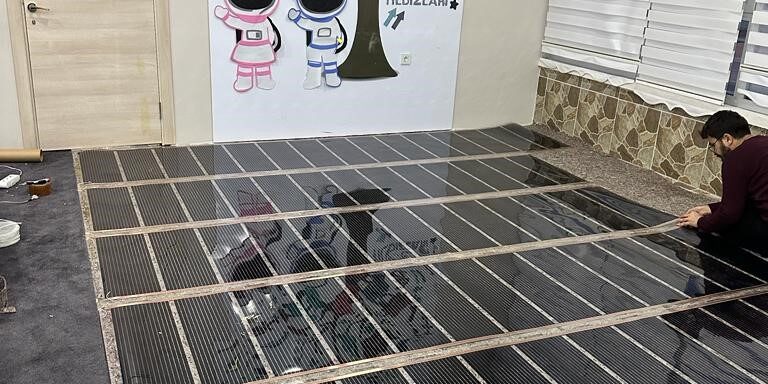
Screedless underfloor heating is a faster, cleaner and more practical solution than traditional systems. In conventional systems the heating pipes are covered with screed, which takes weeks to dry and raises the floor height. Screedless systems eliminate these problems. So how is screedless underfloor heating installed, what are its advantages and what should you watch out for? This guide answers all your questions.
What Is Screedless Underfloor Heating?
Screedless underfloor heating is a system in which heating pipes or electric heaters are laid on special insulation and heat-spreader plates without a screed layer. It can be used in new buildings but is most popular in renovation projects. Installation is quick and the floor build-up is kept to a minimum.
How Does a Screedless System Work?
- Direct installation: The heating elements are placed on top of the insulation layer and covered directly by the floor finish.
- Fast warm-up: With no thick screed mass to heat, the floor warms up quickly.
- Low profile: Adds very little height to existing floors.
Advantages of Screedless Underfloor Heating
- Fast installation: No screed drying time, so the system is ready to use quickly.
- Less labour: No extra cost for screed materials and pouring.
- Fast response: The thermostat set point is reached sooner, saving energy with intermittent use.
- Low profile: Does not affect door and threshold heights – ideal for renovations.
- Lighter load: No screed weight on the floor structure, so it can be used on timber and lightweight floors.
Screedless Underfloor Heating Installation: Step by Step
Correct planning and quality materials are critical for long-term performance. Installation consists of the following steps:
- Floor preparation: The area is cleaned and levelled. An insulation board such as XPS or EPS is laid to prevent heat loss.
- Laying the heating elements: In wet (hydronic) systems, pipes are fitted into grooved heat-spreader plates; in electric systems, heating cables, mats or carbon films are laid on the insulation at the planned spacing and secured.
- Connection and testing: The system is connected to the thermostat and floor sensor. Wet systems are pressure-tested; electric systems undergo insulation and resistance measurements.
- Floor covering: A floor finish suitable for underfloor heating – tiles, laminate, parquet or vinyl – is installed.
Note: Installation by a professional team using quality materials directly affects the system’s safety and lifespan.
Disadvantages of Screedless Underfloor Heating
- Requires careful planning: Incorrect layout or insufficient insulation can disrupt heat distribution.
- Low heat storage: With no screed mass, the floor cools faster when the system switches off.
- Floor covering limitations: Thick carpets and materials with high thermal resistance reduce efficiency.
- Material cost: Special plates and low-profile components can cost more than some conventional systems.
Which Floor Coverings Are Compatible?
- Ceramic and porcelain tiles: Give the best performance thanks to high thermal conductivity.
- Laminate flooring: Products labelled as suitable for underfloor heating are a comfortable and attractive option.
- Natural stone: Marble and granite distribute heat evenly.
- Vinyl: Heat-resistant vinyl is an economical and stylish alternative.
Warning: When choosing parquet, always select models approved by the manufacturer for underfloor heating.
Screedless or Screed? Which System Should You Choose?
In a new building where floor height is not an issue, conventional screed systems offer the advantage of heat storage. For renovations, where threshold height matters or fast installation is needed, a screedless system makes more sense. You will find details of screed cable systems in our cable underfloor heating guide, and all the options in our underfloor heating systems article.
Why Oxa Technologies?
Oxa Technologies has been providing underfloor heating solutions since 2021. Our advantages for screedless underfloor heating projects:
- Quality materials: Durable, energy-efficient heaters, thermostats and control panels.
- Professional installation: Fast, safe installation by experienced teams.
- 2-year warranty: Product warranty plus long-term spare parts support.
- Customer support: Available on +90 536 366 12 81 or at [email protected].
Frequently Asked Questions
Can screedless underfloor heating be used anywhere?
Yes – in homes, offices, bathrooms, conservatories and commercial spaces – provided the insulation and floor covering are suitable.
Does screedless underfloor heating save energy?
Yes. Because the system warms up quickly, it can be run only when needed. To calculate actual consumption, see our article on underfloor heating electricity consumption.
How long does installation take?
For an average room, installing an electric screedless system is usually completed within a day, plus the time to lay the floor covering.
Is screedless underfloor heating better than radiators?
In terms of comfort and aesthetics, yes; in terms of cost, it depends on the project. Read underfloor heating vs radiators for a detailed comparison.
Conclusion
With fast installation, a low profile and quick response, screedless underfloor heating is an ideal solution, especially for renovation projects. For more information or a quotation, call +90 536 366 12 81, email [email protected] or use our contact page.