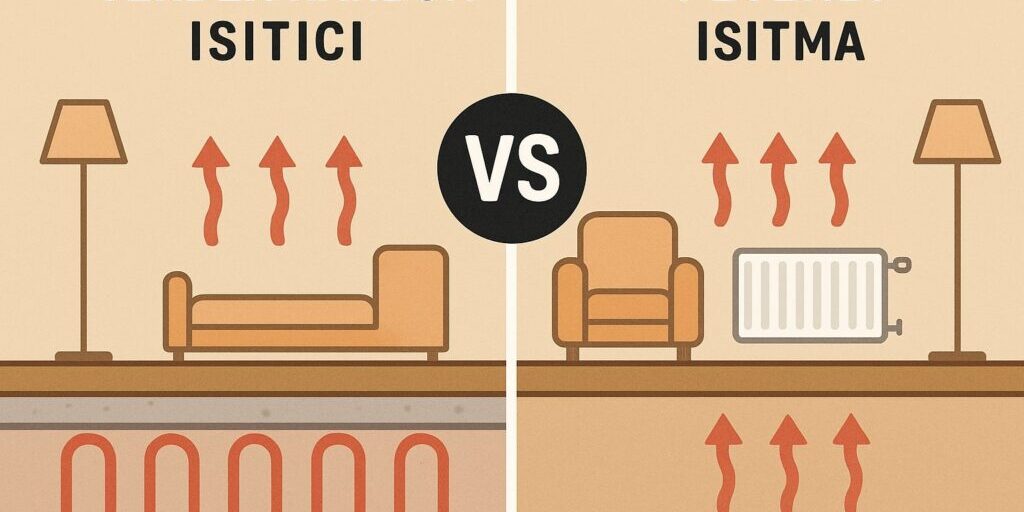
Looking for the best way to heat your home? Underfloor heating vs radiators is one of the most common comparisons when it comes to comfort and savings. In this guide we compare the advantages, disadvantages and costs of both systems to help you decide.
What Is Underfloor Heating?
Underfloor heating heats a space with hot water circulating in pipes beneath the floor (wet system) or with heating cables and carbon films (electric system). Heat rises evenly from the floor. For the different types, see our underfloor heating systems article.

Advantages of Underfloor Heating
- Comfortable heat distribution: Heat is spread evenly and feet stay warm.
- Energy efficiency: Runs at low temperatures; especially economical when combined with a heat pump.
- Aesthetics: No radiators, giving complete freedom in interior design.
- Silent operation: A noise-free heating experience.
- Less dust circulation: Less air movement means less dust is stirred up.
Disadvantages of Underfloor Heating
- Higher installation cost: The initial investment is higher than for radiators.
- Harder repairs: In wet systems, faults beneath the floor can be difficult to reach.
- Slower warm-up: Particularly in screed systems, the room takes longer to heat.
- Floor covering limitations: Thick carpets and some wooden floors reduce heat transfer.
What Is Radiator Heating?
Radiator heating is a traditional system in which hot water circulates through wall-mounted radiators that release heat into the room. It runs from a combi boiler or central boiler.
Advantages of Radiators
- Lower installation cost: More economical than underfloor heating.
- Fast warm-up: Heats the room quickly.
- Easy maintenance: Repairs and replacements are quick and inexpensive.
- No floor restrictions: Compatible with any floor covering.
Disadvantages of Radiators
- Uneven heat distribution: Warm air rises to the ceiling and the floor often stays cold.
- Take up space: Radiators restrict wall space and furniture layout.
- Higher water temperature: Radiators run at higher temperatures than underfloor heating, which can increase energy bills.
- Dust build-up: Dust collects behind and between radiator fins.
Underfloor Heating vs Radiators Compared
| Criterion | Underfloor Heating | Radiators |
|---|---|---|
| Installation cost | High | Low |
| Energy consumption | Lower (economical in the long run) | Higher |
| Comfort | Excellent, even | Moderate, localised |
| Warm-up speed | Slow to moderate | Fast |
| Maintenance | Little, but repairs are harder | Easy |
| Lifespan | Long (decades if installed correctly) | Medium to long |
Note: Costs vary with region, materials, labour and building insulation. A site survey is recommended for an up-to-date price.
Use our underfloor heating electricity consumption guide to calculate the monthly running cost of electric underfloor heating.
Which System Is Right for You?
Choose underfloor heating if:
- you are building a new home or carrying out a major renovation;
- you want long-term energy savings and comfort;
- you want a minimalist interior;
- low dust circulation is important to you.
Choose radiators if:
- your budget is limited or you need a quick solution;
- you are only making minor changes to an existing home;
- fast warm-up is your priority.
If you want underfloor heating during a renovation without breaking up the floor, take a look at screedless underfloor heating and carbon film solutions.

Conclusion: Which Is Better?
Both systems have their own advantages. Underfloor heating offers long-term savings, comfort and aesthetics, while radiators stand out for low initial cost and fast warm-up. When deciding, consider your budget, the structure of your home, your lifestyle and your energy goals together.
Tips:
- Whichever system you choose, improve the building’s insulation first.
- Choose the right energy source – combi boiler, heat pump or electricity.
- Always have a site survey and heat-loss calculation carried out before installation.
Contact us for a free site survey and quotation.
Frequently Asked Questions
Is underfloor heating harmful to health?
No. When properly designed and operated at a suitable surface temperature, it is safe for health.
Which floor coverings suit underfloor heating?
Ceramic tiles, natural stone and laminate approved for underfloor heating are ideal. Thick carpets reduce heat transfer.
Are radiators or underfloor heating cheaper to run?
Because underfloor heating runs at a lower temperature, it is generally more economical to operate – although the initial investment is higher.