Electric underfloor heating consumption with carbon film heaters is based on a power rating of 110–240 W per square metre, but actual consumption equals the room’s heat loss. In a well-insulated 20 m² room used for 8 hours a day, monthly consumption is around 384 kWh – roughly 1,536 TRY per month at an example price of 4 TRY/kWh. In this guide you will find the calculation formula, a cost table by room size, the factors that affect consumption and ways to save.
Quick Answer: How Much Electricity Does Underfloor Heating Use?
Carbon film heaters draw 110–240 W per square metre, but thanks to the thermostat, actual consumption equals the room’s heat loss. In practice, a well-insulated space uses about 80 W/m² per hour, which means 19.2 kWh per square metre per month with 8 hours of daily use. For a 20 m² room that is about 384 kWh/month – 1,536 TRY/month at 4 TRY/kWh.

How Does Carbon Film Underfloor Heating Work?
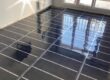
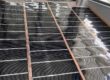
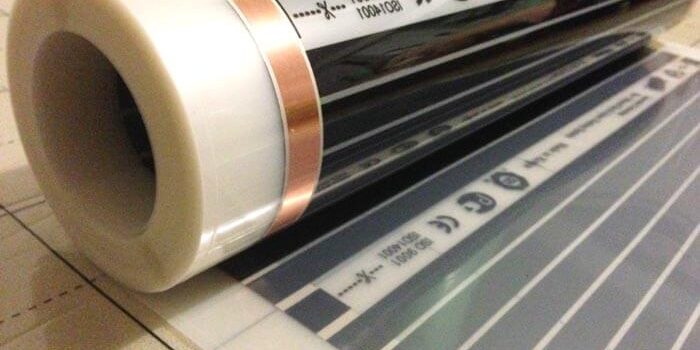
A carbon film heater (see benefits of carbon film underfloor heating for details) consists of conductive carbon strips embedded in a thin polymer film. When current is applied, the carbon conductors heat up and transfer that heat directly to the surface. Because the system works without water pipes, circulation pumps or boiler equipment, energy losses are low.
The film’s power per square metre ranges from 110 W to 240 W. The system must always be used with a room thermostat, which continuously measures the room temperature and automatically switches the film off when the set point is reached. The film therefore runs intermittently rather than continuously throughout the day.
How to Calculate Underfloor Heating Electricity Consumption
When calculating consumption, the basis is the room’s heat loss, not the film’s rated power – because a thermostat-controlled system draws only enough energy to cover the heat loss. The calculation has three steps:
- Determine the room’s hourly heat loss (in watts). For a home with normal insulation, about 80 W per square metre is assumed.
- Divide the hourly heat loss by 1,000 to get hourly consumption in kWh.
- Multiply the hourly consumption by the daily operating hours and the number of days in the month, then by the unit price of electricity to get the monthly cost.
Worked Example: A 20 m² Living Room
The hourly heat loss of a normally insulated 20 m² living room is about 1,600 W. If 15 linear metres of carbon film are laid in the room, total film power reaches 3,600 W. However, the thermostat only allows as much energy as the heat loss; the system is on for an average of 25–26 minutes per hour. Actual hourly consumption is therefore 1.6 kWh.
For 8 hours of operation per day, monthly consumption and cost are: 1.6 kWh × 8 hours = 12.8 kWh/day → 12.8 × 30 days = 384 kWh/month → 384 × 4 TRY = 1,536 TRY/month.
Monthly Electricity Consumption and Cost by Room Size
The table below summarises underfloor heating consumption and monthly cost for different room sizes, based on 8 hours of operation per day, a well-insulated space and an example price of 4 TRY/kWh.
| Room Size | Hourly Consumption | Daily Consumption (8 h) | Monthly Consumption | Monthly Cost (4 TRY/kWh) |
|---|---|---|---|---|
| 10 m² | 0.8 kWh | 6.4 kWh | 192 kWh | 768 TRY |
| 15 m² | 1.2 kWh | 9.6 kWh | 288 kWh | 1,152 TRY |
| 20 m² | 1.6 kWh | 12.8 kWh | 384 kWh | 1,536 TRY |
| 25 m² | 2.0 kWh | 16.0 kWh | 480 kWh | 1,920 TRY |
| 30 m² | 2.4 kWh | 19.2 kWh | 576 kWh | 2,304 TRY |
| 40 m² | 3.2 kWh | 25.6 kWh | 768 kWh | 3,072 TRY |
| 50 m² | 4.0 kWh | 32.0 kWh | 960 kWh | 3,840 TRY |
Note: The values in the table are for well-insulated spaces. In poorly insulated buildings heat loss can be 1.5–2 times higher, and consumption and cost rise by the same proportion. Recalculate costs using your current local electricity price.
Factors Affecting Underfloor Heating Electricity Consumption
Consumption can vary considerably between two homes of the same size. The reason is not the system’s power but the parameters that determine the room’s heat loss. The following factors directly affect consumption:
- Building insulation: In buildings with poorly insulated walls, roofs and floors, heat loss is greater and the system runs longer.
- Window and glazing type: Single glazing or poor-quality PVC frames can account for 20–30% of heat loss.
- Thermostat setting: Each 1 °C increase raises consumption by roughly 6–7%.
- Daily hours of use: How many hours a day the system is on directly determines total consumption.
- Floor covering: Ceramic tiles and natural stone conduct heat well; carpet and thick laminate reduce efficiency.
- Ceiling height: Ceilings above 2.7 metres mean a larger volume to heat.
- Outdoor temperature: In colder climates the system runs for longer.

How to Save Electricity with Underfloor Heating
When correctly designed, carbon film underfloor heating offers clear savings over conventional heating. The following measures can cut your bill by 20–40%:
- Use a programmable or smart thermostat and lower the temperature by 2–3 °C when the home is empty.
- Keep the comfort temperature at 19–20 °C rather than 21–22 °C.
- Check window and door seals; upgrade single glazing to double glazing.
- Lay a heat-reflective (aluminium-faced) underlay beneath the film, and do not neglect subfloor insulation.
- Use zone heating: heat the seating areas in use rather than the whole room, with a separate thermostat for each room.
- Do not cover the film with thick carpets or heavy furniture; this reduces heat transfer and shortens film life.
- Programme a night mode that runs at 16–18 °C.
How Economical Is Underfloor Heating Compared with Other Systems?
Because underfloor heating spreads heat evenly from floor to ceiling, it achieves the same comfort while heating the air to a lower temperature. With conventional radiators, the area near the ceiling can reach 24–25 °C while it feels like 19–20 °C at seated level; with underfloor heating the difference is very small. As a result, a thermostat setting 2–3 °C lower is enough for the same comfort, reducing total energy demand.
Like all resistive electric heaters (other than heat pumps), carbon film converts almost all electricity into heat. The difference is that it delivers that heat directly into the floor rather than the air, so the same comfort is achieved at a lower thermostat setting. Investment costs are low and maintenance costs are virtually zero. For a comparison with wet systems, see underfloor heating vs radiators.
Frequently Asked Questions
How much electricity does carbon film underfloor heating use per hour?
Heat loss, not film power, is what matters. In a normally insulated 20 m² room, hourly consumption averages 1.6 kWh; in well-insulated buildings this can fall to 1.0–1.2 kWh.
How much higher will my bill be without a thermostat?
Running without a thermostat is theoretically possible but raises the cost 2–2.5 times and shortens the system’s life. Carbon film heaters must always be installed with a thermostat.
Which floor covering is most efficient?
Ceramic tiles and natural stone conduct heat best. Laminate and parquet can be used, but their thermal resistance should not exceed 0.15 m²K/W. Efficiency can drop by up to 30% where carpet is laid.
Can carbon film underfloor heating be the only heating system in a home?
Yes. In a home insulated to current standards, it can be used as the sole main heating system. In poorly insulated buildings, it is best planned together with supplementary heating.
Does it need maintenance after installation?
Carbon film heaters have no moving parts, so in practice there are no maintenance costs. Simply check once a year that the thermostat is working correctly.
Conclusion
Correctly designed, carbon film underfloor heating is a modern solution offering low investment cost, silent operation and high comfort. A monthly consumption of 384 kWh (about 1,536 TRY) can be taken as a reference for a normally insulated 20 m² room; with good insulation, correct thermostat use and zone heating, this figure can be reduced by 20–40%.
For an alternative method based on installed power and duty cycle, see our carbon film heater bill calculation guide. Using this method you can easily calculate each room and avoid surprises before installation. You will find the different system types in underfloor heating systems and consumption scenarios for cable systems in our cable underfloor heating guide.
Contact us for under-carpet heaters, thermostats and carbon heating film control panels. We supply materials and installation throughout Türkiye.