How hot does a carbon film heater get? This matters for both safety and comfort. The answer depends on the film’s power, the floor covering above it and, above all, the thermostat setting. In this guide we look separately at the temperature of the film itself, the floor surface and the room.
Three Different Temperatures: Film, Floor and Room
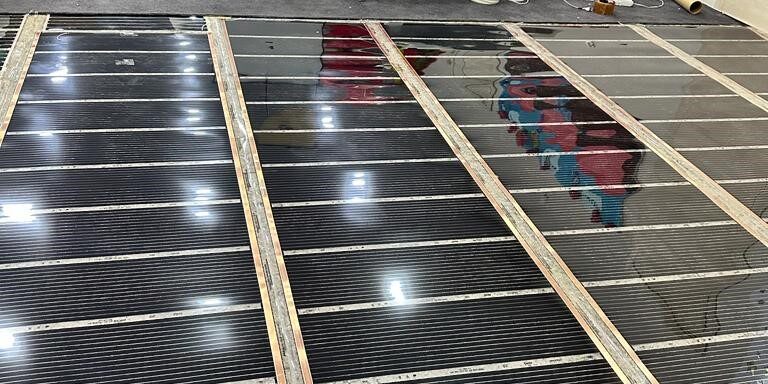
- Film temperature: The temperature of the layer containing the carbon strips. Run uncovered and uncontrolled, it can reach around 40–60 °C depending on the film’s power.
- Floor surface temperature: The temperature of the top surface of the carpet, parquet or laminate. This is what determines comfort and safety.
- Room temperature: The air temperature set on the thermostat, typically 20–22 °C.

Recommended Floor Surface Temperatures
The accepted approach in underfloor heating is that the floor surface should not exceed 29 °C in areas where people sit and walk regularly. This limit provides heating that is both comfortable and healthy.
| Floor Covering | Recommended Maximum Surface Temperature |
|---|---|
| Carpet (living areas) | 27 – 29 °C |
| Laminate | 27 – 28 °C (follow the manufacturer’s value) |
| Wood parquet | Usually 27 °C |
| Mosque carpet | 27 – 29 °C |
| Perimeter and little-used areas | Up to 35 °C |
Parquet and laminate manufacturers may specify different limits; the value in the product documentation always takes priority.
How Is the Temperature Limited?
A carbon film has no temperature limit of its own (except PTC films), so temperature is controlled by the thermostat:
- Room sensor: Switches the film off when the air temperature reaches the set point.
- Floor sensor: Cuts the film if the floor temperature exceeds the set limit, regardless of room temperature. We explain why this matters in our floor sensor article.
Under carpet and parquet, the safest approach is a thermostat that works on air temperature and is limited by a floor sensor (AF mode). See our thermostat guide for help choosing one.

Factors Affecting Surface Temperature
- Film power: A 240 W/m² film heats faster and reaches higher temperatures than a 180 W/m² film. Details: wattage comparison.
- Covering thickness: Thick carpet increases the temperature difference between the film and the surface.
- Trapped heat: Cushions, floor mattresses or closed-base furniture on the film raise local temperatures.
- Underlay insulation: Without insulation, heat escapes downwards and the surface warms more slowly.
Frequently Asked Questions
Can a carbon film heater burn the carpet?
In a thermostat-limited system, the surface temperature is far below the level that could damage a carpet. For safety rules, see are under-carpet heaters safe?
Will the room warm up if the floor is only 29 °C?
Yes. Because underfloor heating releases heat at a low temperature over a large area, a room temperature of 20–22 °C is easily reached in adequately insulated rooms.
Does raising the temperature heat the room faster?
Slightly, in the short term – but comfort and safety limits must not be exceeded. For warm-up times, see this article.
Conclusion
Running uncontrolled, a carbon film can reach 40–60 °C, but in a correctly installed system the floor surface is kept at around 27–29 °C. The way to achieve this is a thermostat with a floor sensor. Contact us for help choosing products and thermostats.