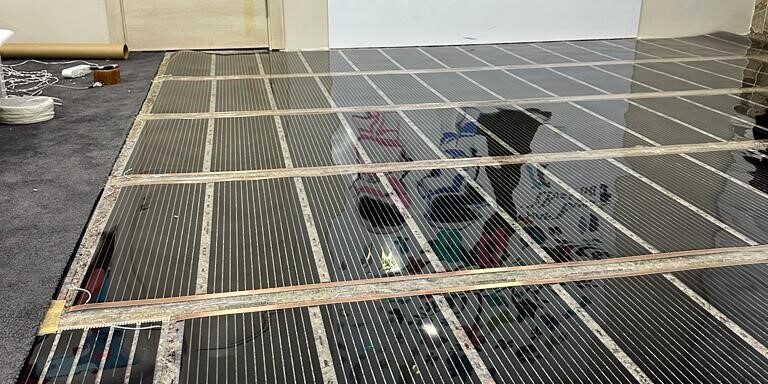
When researching carbon film heater prices, you may wonder why prices per square metre vary so much. Two products that look identical can differ greatly in price – and most of that difference comes down to quality, materials and certification. In this article we explain the factors that determine price, the elements of total project cost and how to compare costs properly.
Because prices change frequently with exchange rates, raw materials and labour costs, we do not quote fixed figures here. Request a quotation for current prices.
Factors Affecting Product Price
1. Film Quality and Materials
- Carbon ink quality: Evenly printed carbon strips give uniform heat and do not lose power over time.
- Busbar material and cross-section: Thick copper or silver-enriched busbars heat up less and avoid voltage drop over long runs.
- PET layer thickness and lamination: High-quality lamination improves resistance to moisture and mechanical impact.
2. Power and Width
Film power (W/m²) and width (50/80/100 cm) affect the price per square metre. However, higher power is not always better – the power must suit the space.
3. Technology Type
In addition to standard carbon films, there are PTC (self-regulating) films whose power decreases as temperature rises. PTC films cost more but provide extra protection against trapped heat.
4. Certification and Testing
Products with CE marking, independent laboratory test reports and quality certificates cost more, but make a real difference to safety and service life.
5. Warranty and Technical Support
Suppliers offering long warranties, spare parts and on-site service may look more expensive at first, but they offer a lower total cost of ownership.

Elements of Total Project Cost
Looking only at the film price is misleading. The total cost is made up of:
| Item | Description |
|---|---|
| Carbon film | Net laying area × price per m² |
| Connection materials | Clamps, insulating tape, cable |
| Underlay | Thermal insulation felt, moisture barrier |
| Thermostat and sensor | Per room or zone |
| Control panel | For large areas: breakers, RCDs, contactors and timer |
| Electrical infrastructure | New circuit or supply upgrade if needed |
| Labour | Laying, connection, testing and commissioning |
In large projects such as mosques, panel and infrastructure costs account for a significant share. See mosque power calculation and control panel for details.
Don’t Forget Running Costs
A cheap but inefficient installation can wipe out the initial saving through higher bills within a few seasons. Underlay insulation, the right thermostat and the right power rating directly reduce running costs. Use our carbon film heater electricity consumption guide to estimate your monthly bill.
How to Compare Quotations Properly
- Ask whether the square-metre figure refers to net film area or room area.
- Request the film power (W/m²), width and brand/model.
- Check whether the thermostat, panel, underlay and labour are included.
- Get the warranty period and coverage in writing.
- Ask for the CE declaration and test reports.
Frequently Asked Questions
Why do carbon film heater prices per m² vary so much?
Differences in carbon ink, busbar material, lamination quality, technology (standard or PTC), certification and warranty all directly affect price.
Is it sensible to buy the cheapest carbon film heater?
Usually not. Low-quality films can lose power over time, develop hot spots and create safety risks. We list the selection criteria in our buying guide.
Is installation included in the price?
It depends on the supplier. A turnkey quotation including materials and installation makes comparison easier.
Conclusion
Carbon film heater prices depend on factors such as film quality, power, technology, certification and warranty. For a fair comparison, look at total project and running costs as well as the product price. Contact us for an up-to-date quotation for materials only or with installation.