Two popular electric radiant heating solutions are carbon film heaters and infrared panel heaters. Both heat surfaces and people rather than the air, but they differ in mounting location, surface temperature and purpose. In this article we compare the two systems.
Key Differences
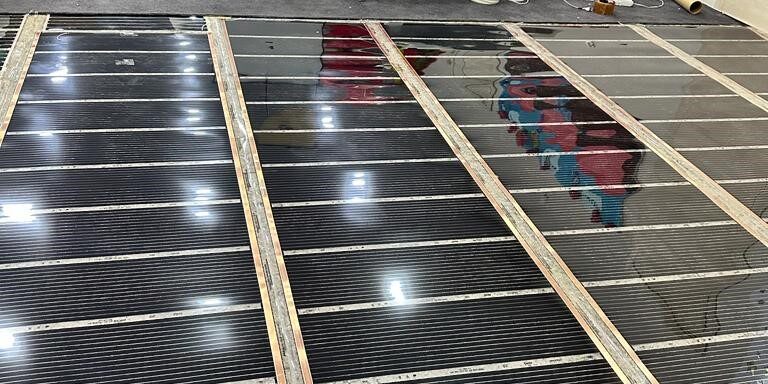
- Carbon film: Laid beneath the floor covering. Heats a large surface at a low temperature (floor surface ≈ 27–29 °C).
- Infrared panel: A panel mounted on a wall or ceiling. Emits radiant heat from a small surface at a high temperature (usually 80–100 °C or more).
Comparison Table
| Criterion | Carbon Film | Infrared Panel |
|---|---|---|
| Installation | Under the floor, with the covering lifted | Wall or ceiling, screw-fixed |
| Visibility | Completely hidden | Visible panel |
| Surface temperature | Low | High |
| Heat distribution | Even across the whole floor | Focused in the direction the panel faces |
| Installation time | Longer | Very short |
| Portability | Limited | Easy |
| Suitable spaces | Homes, mosques, schools, floors people sit on | High-ceilinged areas, workshops, spot heating, bathrooms |

Efficiency and Consumption
Both are resistive heaters that convert almost all electricity into heat. The difference lies in where that heat goes:
- Carbon film heats the floor people sit and walk on, spreading comfort across the whole room.
- An infrared panel quickly warms the person and surfaces in front of it; the effect decreases with distance from the panel.
For consumption calculations, see our carbon film electricity consumption guide.
Which to Choose When?
Carbon film is better for:
- spaces where people sit on the floor (mosques, children’s rooms, living rooms);
- invisible, even heating;
- floor renovations or under-carpet installations.
Infrared panels are better for:
- situations where the floor cannot be touched;
- spot heating in high-ceilinged workshops and warehouses;
- areas that need fast, short-term warmth.
The two systems can also be combined – for example, carbon film on the floor of a conservatory and an infrared panel near the glazing. See carbon film for conservatories and enclosed balconies.
Frequently Asked Questions
Are infrared panels and carbon film the same technology?
Some infrared panels use a carbon heating element inside, but the panel is designed to operate at a high temperature over a small area, whereas carbon film operates at a low temperature over a large area.
Which is safer?
Both are safe when installed correctly. Because an infrared panel’s surface is hot, attention must be paid to contact distance.
Conclusion
Carbon film is better for even, invisible heating from the floor, while infrared panels suit fast, targeted heating without touching the floor. Contact us for the right choice for your space, or read what is a carbon film heater? for the basics.